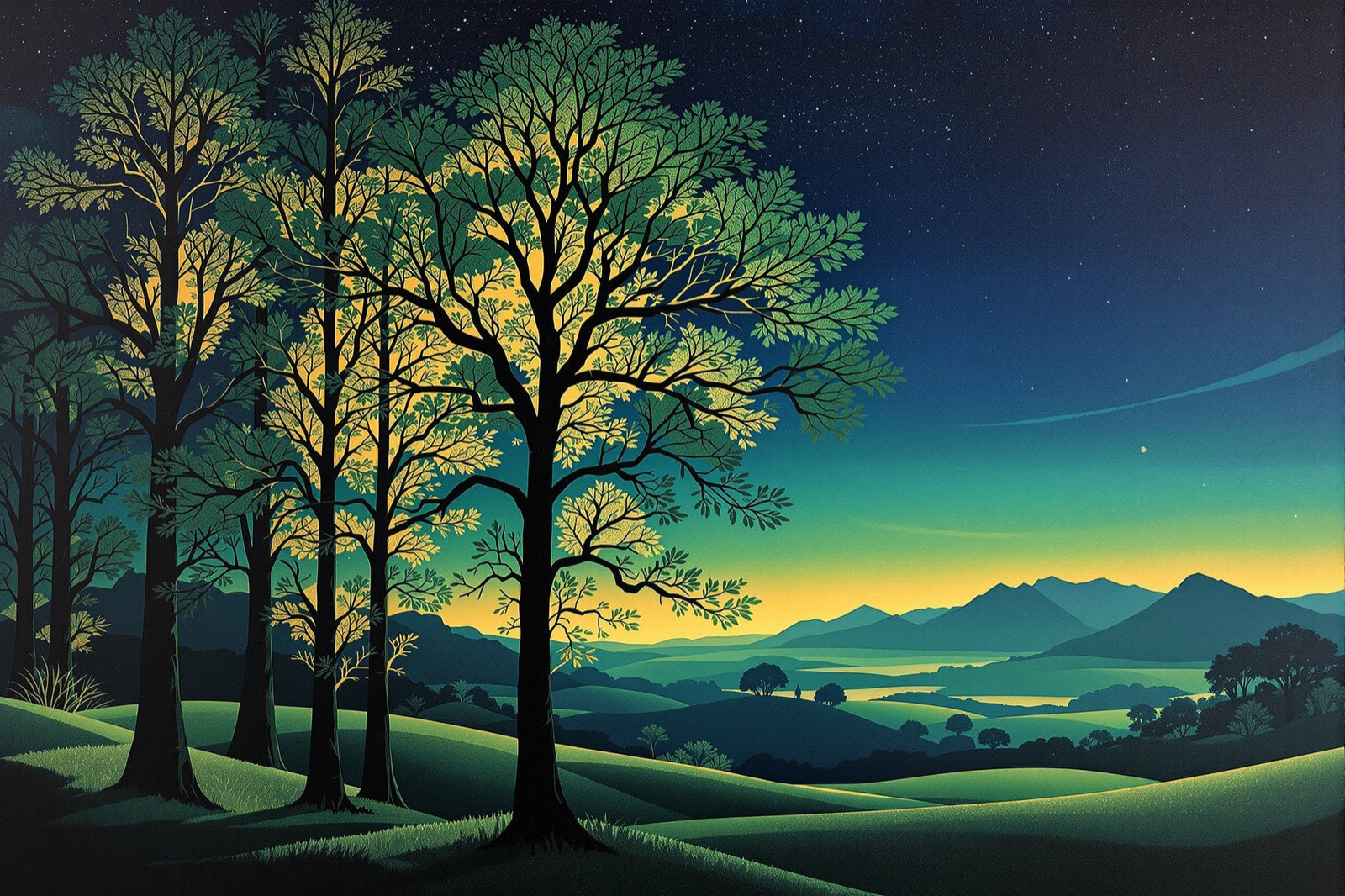
Eyvind Earle: Designer of a Sleeping Forest
Few artists in animation history imposed a personal vision on a feature film as completely as Eyvind Earle. The 1959 medieval epic he styled looks like no other film before or since: gothic verticals, medieval tapestry flatness, jewel-box color, forests built from geometry. His concept paintings and production backgrounds appear on the concept art page; this companion essay tells his story in full.
A Painter from the Start
Earle was born in New York City in 1916, the son of a portrait painter who set him a famous childhood discipline: every day, read fifty pages of a book or paint a picture. Earle chose painting, relentlessly. At twenty-one he bicycled across the United States, painting watercolors along the way, and by his early twenties he had exhibited in New York galleries. His serene, hyper-detailed landscape style earned him a long career in fine art and a thriving business designing Christmas cards — he produced hundreds of designs whose snowy hillsides and stylized trees became an American holiday vernacular. His paintings entered major public collections, including the Metropolitan Museum of Art.
The Studio Years: 1951–1958
Earle joined the Burbank studio in 1951 as a background painter and rose with startling speed. He painted backgrounds and contributed styling to the celebrated stylized shorts of the era — including an Oscar-winning 1953 toot-whistle music-history short that broke the studio's house realism with flat modern design — and served as color stylist on the pirate adventure and the candlelit-supper romance. Then came the assignment of his life: production designer for the medieval epic, in production for most of the decade. Earle painted the key concept art and an extraordinary number of the finished production backgrounds himself, insisting on a unified style derived from medieval illuminated manuscripts, Persian miniatures, and pre-Renaissance painting. The film consumed years and a record budget, and its initial box office disappointed; its reputation, and Earle's, have climbed ever since. He left the studio in 1958, before the film's release, to return to fine art.
The Serigraph Decades
From the 1970s until his death in 2000, Earle produced the work most collectors encounter first: limited-edition serigraphs — silkscreen prints of astonishing technical complexity, sometimes requiring dozens of hand-pulled color layers — alongside original oils and watercolors. His subjects rarely changed: California hills, cypress and eucalyptus, snow, fog, stylized horses, light breaking through dark trees. The discipline his father set in 1926 never loosened; Earle painted virtually every day of his life.
What Collectors Look For
Earle material divides into three markets. His studio concept paintings and production backgrounds from the 1950s are the rarest and most contested, prized equally by animation collectors and mid-century design collectors; attribution and studio provenance drive everything, since the background department painted in his style under his supervision — a documented Earle-painted background is a different object from a department background after his design. His fine-art originals occupy a steady gallery market. And his serigraphs offer an accessible entry point, with edition size, condition, and printing complexity setting the tiers. Across all three, the collecting guide's advice applies: documentation first, condition second, beauty always. A collector who hangs one of his deep-green forests learns quickly why animators called the medieval epic's style a cathedral made of trees.
Earle in the Exhibition Gallery
Awaking Beauty: The Art of Eyvind Earle is scheduled for October 23, 2026–April 18, 2027 at the founder's family museum. Roughly 200 works bring together studio art and personal work, including pieces absent from the 2017 retrospective and recently acquired paintings.
The museum describes some backgrounds as taking nearly ten times longer than a typical studio background. That detail gives the patterned scenery another dimension: time invested in an image made for movement. Our survey of animation exhibitions places Earle's presentation beside shows devoted to color, drawing, and the people behind the frames.