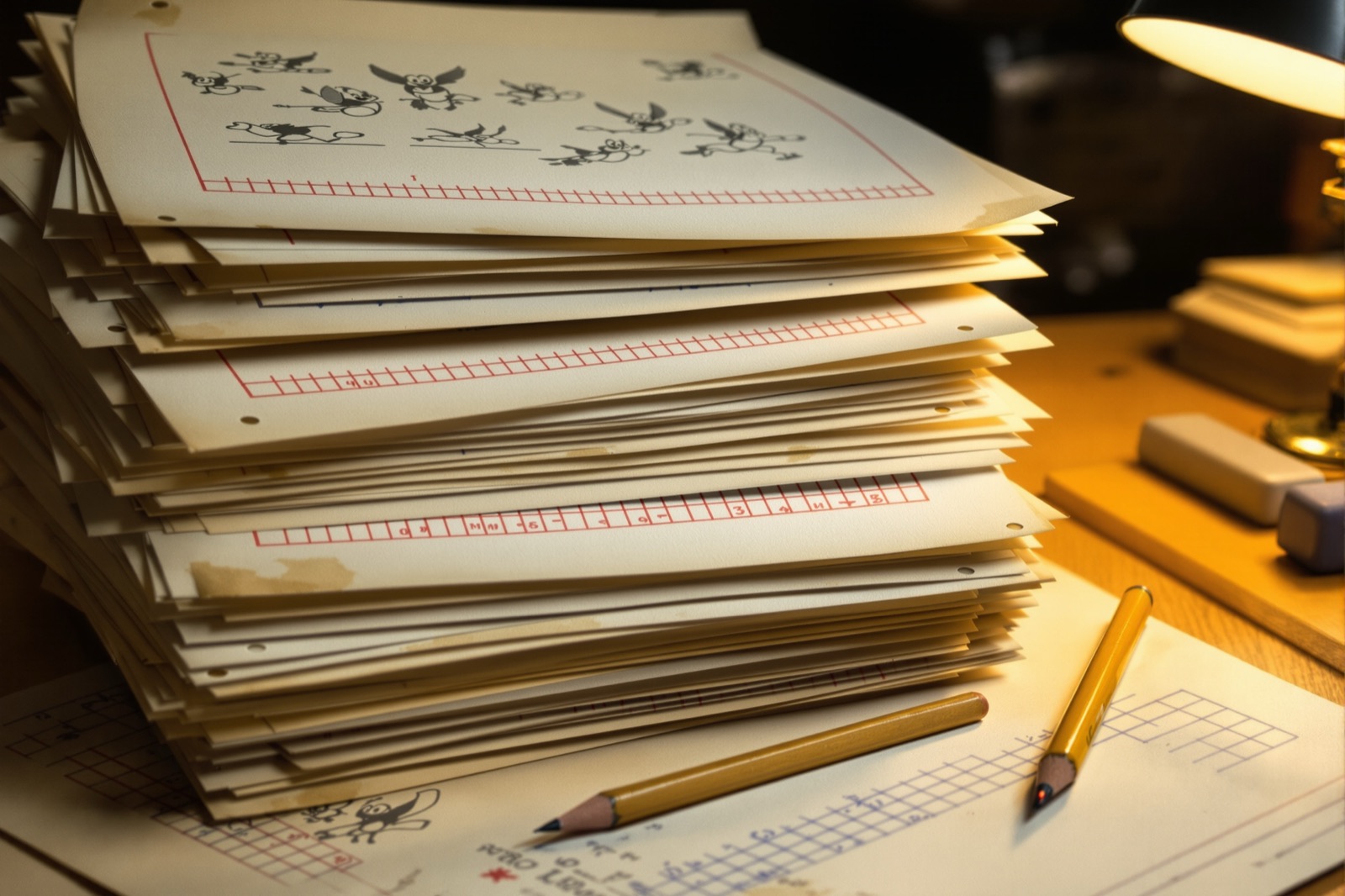
Animation Drawings, 1932–1959
Before paint, there was pencil. Every second of golden-age animation began as a stack of graphite drawings — twelve to twenty-four for each second of screen time — flipped and re-flipped by animators until movement felt alive. The Cuckoo Comics catalog spans nearly three decades of this art, from Depression-era mouse shorts to the last great hand-styled feature of 1959, and shows what a deep drawings collection looked like.
The 1930s Shorts: Where Animators Learned to Act
The earliest entries came from the black-and-white and early-color shorts of 1932–1939: a 1932 Yukon adventure, the 1933 airmail-aviation short, a pair of 1933 puppy-romance drawings, a 1934 high-seas kidnapping caper, a 1934 dognapping rescue, a 1934 steamroller escapade, the 1935 ice-skating outing, a 1937 stage-magician routine, the 1938 giant-slaying fable, and a 1939 dog-show comedy. Drawings from this era show animation discovering itself: rubber-hose construction giving way to weight, anatomy, and genuine character acting. One standout was a 1933 background layout drawing signed by Les Clark — one of the studio's legendary core animators, the first of the so-called Nine Old Men — which paired a working document with an autograph, the kind of crossover piece drawings collectors hunt for years.
The Features: 1937–1940
The feature-era entries included four animation drawings from the 1937 fairy-tale landmark, a pair from the 1940 marionette fable, and several from the 1940 concert feature — among them a drawing of the imperious sorcerer whose name, famously, is the studio founder's spelled backwards, sold as a pair with a companion drawing. Feature drawings are typically larger, more refined, and more carefully archived than shorts material, because the studio understood by 1937 that it was making history. Many sheets carry production numbers, scene numbers, and animator notations in the margins — cataloging data that doubles as provenance, as our collecting guide explains.
Story and Concept Drawings
Two categories on the page reached beyond animation drawings proper. A 1937 storyboard-or-publicity drawing of the magician routine showed the gray zone between story art and promotional art. And from the 1959 medieval epic came three story concept drawings attributed to Kay Nielsen, the great Danish illustrator whose haunted, art-nouveau imagination shaped the studio's most ambitious sequences. Nielsen's golden-age book illustrations are held by major museums; his studio concept work is correspondingly treasured, and drawings bearing his attribution are studied against documented examples in collections such as those described by the Library of Congress Prints & Photographs Division.
Caricature Interlude: 1938
The catalog closed with two pairs of drawings from a 1938 short that gently lampooned Hollywood stars as nursery-rhyme characters — caricature animation at its most exuberant. Caricature shorts are a favorite of crossover collectors from classic-film fandom, since each drawing is simultaneously animation art and a celebrity portrait of the studio era.
Why Collect Drawings?
Drawings are the most democratic corner of animation art. They survive in greater numbers than cels (graphite does not flake or stick the way cel paint does), they cost less than painted set-ups, and they sit closest to the animator's hand: no inker, no painter, no assembly — just the artist thinking on paper at full speed. A rough drawing with energy lines, smeared graphite, and red-pencil corrections is a literal record of a master at work. For new collectors, a well-chosen drawing from a beloved film is the single best first purchase in the hobby, and the cel-making guide shows exactly where each drawing fit in the production pipeline.